

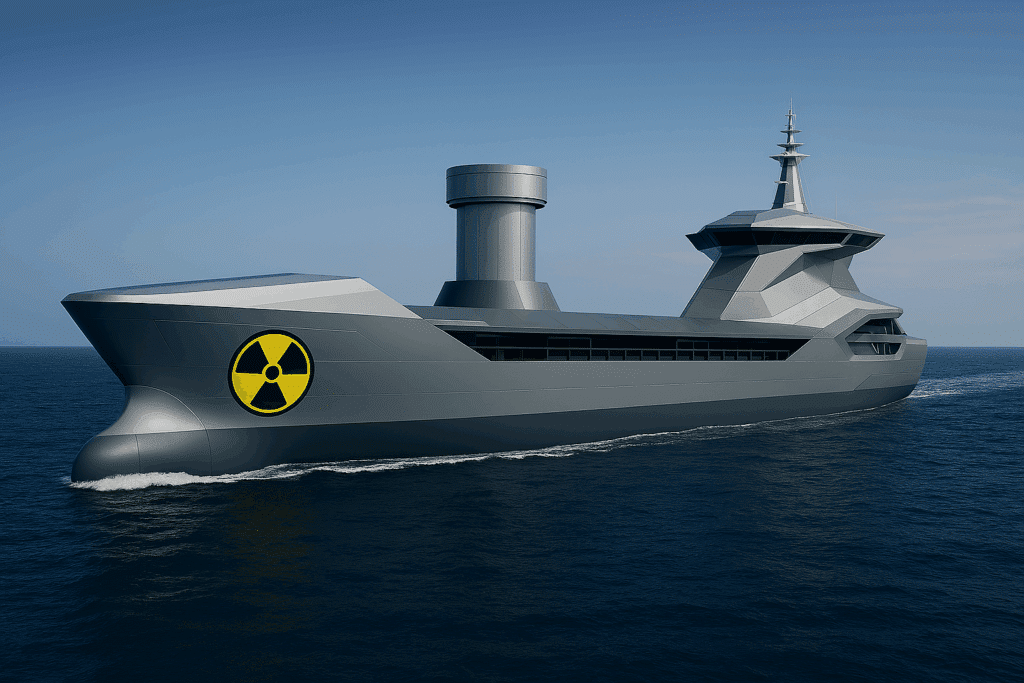
It is evident that nuclear already today plays a large part in our global energy mix and that it will continue to grow in the near future, as several countries have plans of either expanding their use of nuclear energy or introducing modern reactor technology to their energy mix. Further, recently we have seen private companies, including Google, Microsoft and Amazon, drive large investments into modern nuclear reactor technology with plans of generating electricity for their operations.
For shipping, nuclear has three main potential value drivers;
1) On board vessels for propulsion and power generation
2) Energy generation for ports, terminals and land operation
3) Electricity and heat input to PtX processes and e-fuels generation.
It is clear that the potential of nuclear as part of shipping’s transition away from fossil energy is huge as it;
– is free from direct GHG emission
– has a relatively low expected life-cycle impact, both in relation to GHG and other negative impact such as land, water and resource exploitation
– has a very high energy density and expected fuel cycles between 5 and 30 years
– has low shore infrastructure requirements, and no need for global fuel availability
– has a great safety record compared to alternatives
However, it is also clear that nuclear has a set of challenges and barriers, both in relation to land, floating and onboard applications, which must be addressed. Some of the main ones are;
Technology maturity
Currently none of the modern SMR (with passive safety mechanisms) are in operation (outside China and Russia) and most of the actors aiming to bring one to market, focus either solely on land or floating installations – at least they prioritize them first. Even for land and floating applications most on the companies involved does not expect to have the first reactors ready and licensed till early-mid 2030s. It is also worth mentioning that the plans/goals for the different aspiring new reactor producers have in many cases already moved back some years from their original plans, therefore it is likely that at least some of them will see further delays. The main driver for these delays is not necessarily a question of technology, but rather regulation, which to some extent is out of the hands of the technology vendors.
Regulation
We need changes in regulation if we are to scale the SMR reactor production and realize cost benefits on any of the potential value drivers. If we are out use it on board our vessels, we need changes to both maritime and nuclear regulation and an update of international conventions. Below are some of the main regulatory concerns which must be addressed;
Licensing standardization/streamlining To bring reactor production to scale, there is a need to standardize licensing for the reactors. Currently, when a reactor is built is has to live up to very detailed licensing schemes that is set by the local nuclear authority and is specific to the different county’s approach to safety. Currently, all the countries with nuclear energy are discussing safety approaches in IAEA, which is likely therefore the right place to discuss streamlining or standardizing licensing. This standardization, or at least mutual recognition of the different approaches, is key if we are to bring reactor production up in scale and minimize cost and likely also key for both onshore, floating and oceangoing applications.
Liability Currently, nuclear reactors in operation are state owned, insured and regulated under one nation’s jurisdiction. If we are to start moving active reactors around in international waters and between jurisdictions, we need to revisit the international liability and compensation conventions. There are approximately 15 different international conventions addressing nuclear, but the main one is the Brussels convention on the Liability of Operators of Nuclear ships, which was adopted in 1962 under the auspices of IMO, but never ratified by most nations. This convention likely needs to be rewritten in a manner that leaves out military use and take new technology (and the needed emergency planning zone (EPZ)) into consideration in a manner that can not only be adopted, but also be ratified and written into the national laws around the world. The Paris Convention on Third Party Liability in the field of nuclear energy (under OECD) and the Vienna Convention on civil liability for Nuclear Damage (under IAEA) likely both also need to be revisited or aligned with an updated version of the Brussels convention.
The insurers, P&I clubs, will likely pay a large role in this. Currently, everything related to nuclear is exempt from coverage by the P&I clubs, so that needs to be addressed before a private vessel can be put in operation. Nuclear for propulsion was put on the agenda of the International Group of P&I clubs (IGP&I) a couple of weeks back and their work is vital for our ability to insure vessels with reactors on board and the reactors on board vessels. It will likely still require an update to international conventions on liability and compensation and maybe even a split of the reactors and vessel insurance
Maritime regulation IMO nuclear guidelines, nuclear code and SOLAS chapter 8, likely all need to be revisited if we are to see nuclear used for power generation onboard oceangoing vessels. The expectations are that a group will propose this at the MSC 109 meeting in June 2025. If a simple majority decide to go forward with it (which is expected) it will either be put on the main MSC agenda or pushed down to the relevant subcommittees. Even if everything goes as planned, judging from the normal process in IMO, we are likely somewhere in the mid-2030s before any changes can be put up for vote in IMO and implemented if voted through.
Proliferation
The international laws and treaties on nuclear proliferation are rather strict to prevent the spread of nuclear weapons. However, that is not expected to have much affect on the use of SMR reactors technology, as the fuels that are being looked at by most of the companies involved in the field are not enriched to a degree where they are weaponizable. They will therefore likely not fall under the non-proliferation agreements. Further, the main treaty on the non-proliferation of nuclear weapons encourages use of nuclear technology for peaceful purposes under IAEA safeguards, which the energy generation purpose falls under, both on shore, floating and oceangoing.
Public perception
While many countries either have or are planning to have nuclear power as part of their energy mix, nuclear power is still dealing with a general negative public perception, which is also impacting politics, ports and port authorities around the world. In democratic countries, public opinion in most cases drives and impacts politics, so if we are to change international conventions and national law on nuclear, it is a political question and therefore likely relying on the public opinion in the different countries. Denmark has historically for many years been against nuclear, but a poll done a couple of years back, showed a small majority of the population being for looking into the potential of nuclear. This week several political parties have publicly in leading newspapers agued for looking into the potential of modern nuclear technology. The same trend is reported from other previously nuclear negative countries, especially as the knowledge on the safety of the modern reactor technology is becoming more widespread. It is however impossible to guess if this trend continues and how long the swift in opinion takes to embed into all political levels etc.
Fuel Cycle
Currently the fuel production is heavily affected by geopolitics and has a high price volatility. Further, while the industry is capable of producing the fuel for the reactors in operation today with relatively low life-cycle impact and are able to recycle large parts of it, we currently do not have a full overview of the exact types of fuel, and the quantities of them, which will be used in the different stems of modern reactor technology. Therefore, we do not know the complete picture of the cost, the life cycle impact from producing them, the amount of waste they generate and how much of it we will be able to recycle. We are currently able to recycle around 96% of the waste generated from the light water reactors in operation today, but we are currently not able to recycle the waste that will be generated by the more modern reactor technology.
Supporting industry
The supporting industry for nuclear reactors have been in decline for decades, as very few new reactors are being built. This has led to companies diverting to other industries and a decline in the workforce with the required skills. It is a challenge all the way from welders to nuclear engineers and everything in between. The challenge only becomes amplified when looking at it from an onboard vessel perspective, as we need to reeducate and build the industry from the ground up.