

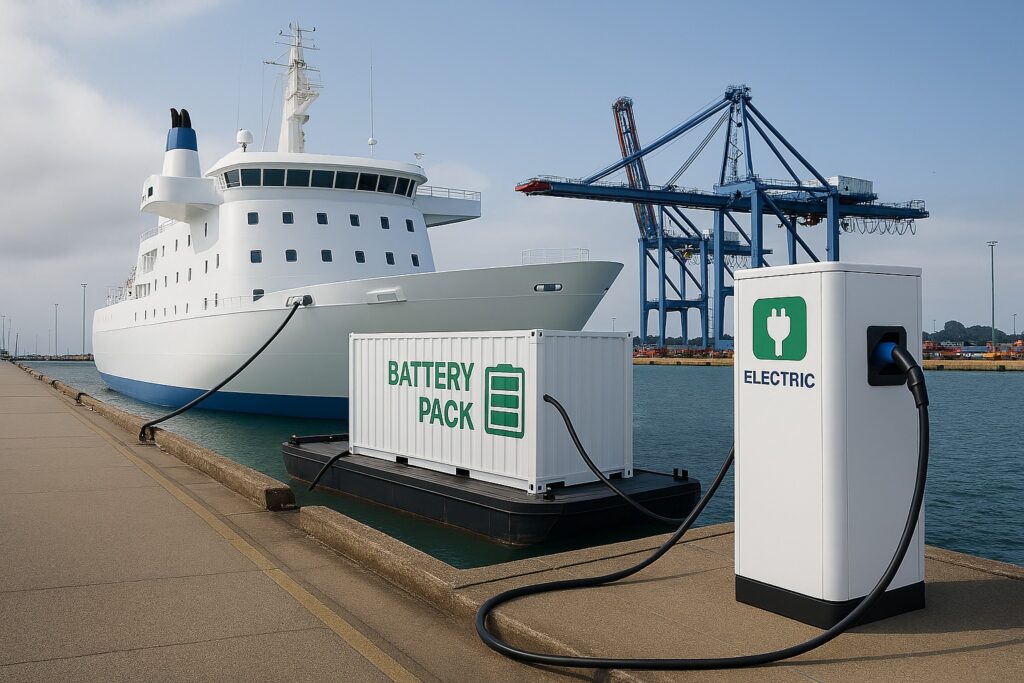
It is evident that electrification already plays and will continue to play an important part in the reduction of both society’s and shipping’s impact on the climate and environment. It reduces (or eliminates) onboard GHG emissions and air pollution and heavily contributes to reducing the noise from the vessels. Further, it comes with reduced operating costs as there are fewer moving parts and therefore less wear and maintenance needed. The energy efficiency is also typically much better than on combustion engines and especially the energy losses from well-to-wake, or from renewable energy source to propeller, are majorly dwarfed by those of any other renewable energy vector that is currently in the shipping community’s option field. This is both important from a shipowner cost perspective and for society as our renewable energy is still scares.
However, electrification also comes with challenges that can be grouped into four main categories:
1) Battery (and electrical energy storage) technology limitation
The energy density of batteries is still low compared to other existing and potential marine fuels, this means that they weigh more and take up more space, which limits cargo capacity and range. Further, the charging times take longer than liquid or gaseous fuels, which increases downtime for the vessel. Last but not least, the battery life span is still relatively short and the climate and environmental impact of battery production is still high. This combined with our limited ability and the high cost associated with recycling batteries poses a sustainability challenge.
2) Charging infrastructure and grid capacity
The limited availability of charging infrastructure in ports is one of the main, if not the main limitation for electrification of vessels. There are significant investments needed to build the charging stations, especially now we are reaching the need for high megawatt charging. Establishing these is also challenged by the lack of positive business cases for terminal or port owner/operators, which is central to the establishment. Positive business cases are today mainly (if not only) seen in liner operations where typically RORO or ROPAX vessels are calling the same ports regularly and the systems therefore have a high usage. The charging ability is further hindered by local grid capacity as the charging systems put a large strain on the local electricity grids. Especially the vessels with large battery packs and the need for fast charging, and where several ships potentially need to charge or connect to onshore power supply at the same time, is challenging for the local grids. This problem is only amplified as we are seeing general moves toward electrification in ports, where heating, cooling, cargo handling and operation, etc. are also putting increasing demands on the grids. This requires increased capacity from the TSO-operated national grids to the local DSO-operated grids and down to the ports and terminals. This can be done, but it is costly and takes time and in the eyes of the energy companies, TSOs, and DSOs shipping and ports are still very small fish in a large ocean dominated by data centers, industrial areas, and power producers who also need increased capacity.
3) High initial cost both on board and on land
The CAPEX cost of electrical or hybrid vessels is still generally higher than for conventional fueled vessels. This is especially due to the batteries, but also the electrical propulsion systems, integration, and related technology are bringing up costs. This is especially a challenge in retrofit cases, where the mechanical and electrical integration often cost just as much as the battery pack.
4) Lack of standardization
Currently, there are no universally accepted standards for electrification of shipping and we are still seeing differences in charging interfaces, power levels, etc. across different regions and vessel types, but also in the same geographical areas and similar vessels. This is a challenge also faced when looking at shore power systems.