

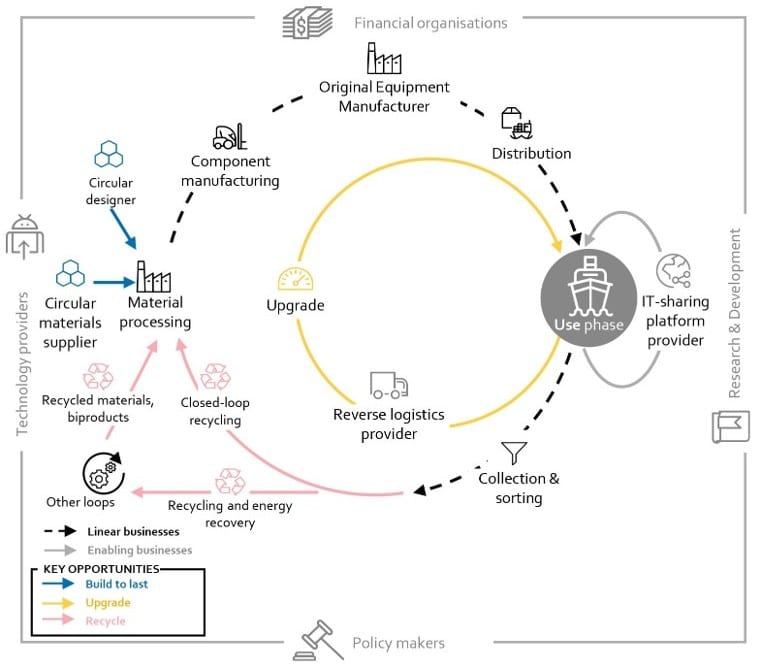
Circularity and the circular economy are expressions of the opportunity and need to turn inefficiencies in a linear value chain into value, both financially and environmentally, through circular business models and principles.
Apart from the potential additional value created by turning business models more circular, companies are also increasingly facing external pressure to do so from regulators, customers (mainly B2B) and investors. Especially EU regulation has been driving attention, not only by directly pressuring organizations through initiatives such as the European Green Deal, Circular Economy Action Plan, EU Taxonomy etc. but also indirectly puts pressure on them as their investors, suppliers and customers are also being pressured through regulation targeting them.
Accenture, Sitra and Nordic Innovation have identified five main areas, throughout value chains, where companies can reduce inefficiencies and create value:
1. Reform resource use, through circular inputs
2. Optimize capacity use, through sharing platforms
3. Offer outcome-oriented solutions, through focus on service rather than transfer of ownership
4. Extend life cycles, though repair, maintenance, upgrading, resale and remanufacturing
5. Recover value in waste, through focus on recovering unusable resources or energy from waste/by-products
Circular Opportunities and Challenges in the Maritime Industry
The maritime industry presents a wide range of circular economy opportunities across the entire vessel lifecycle. The potential for value creation depends on the organization’s role in the value chain and its position in the vessel’s life cycle – from design and construction to operation and end-of-life management.
Circular strategies can be implemented from the early stages of vessel construction by using renewable, recyclable, or bio-based materials, and by designing vessels and components for durability, repairability, and retrofitability. During operations, further value can be unlocked through optimizing vessel and equipment utilization, minimizing energy use, selecting recyclable or biodegradable consumables and fuels, and extending component life through systematic repair, maintenance, resale, and remanufacturing strategies. Finally, at end-of-life, circularity involves recovering resources and energy from decommissioned vessels and components.
Data and Standardization as Enablers
Developing viable business cases for circularity pilots requires access to standardized, high-quality data – similar to the challenges currently experienced in performing lifecycle assessments (LCA). Cross-industry solutions have emerged in sectors such as automotive, aerospace, and heavy machinery, and these offer valuable models for the maritime sector to learn from.
Currently, most efforts focus on greenhouse gas (GHG) emissions – one of the planetary boundaries that is more quantifiable. It is pragmatic to start with carbon and GHG-related inefficiencies as a first step toward broader circular initiatives. Demonstrating value through such pilots – aligned with corporate climate goals – can build momentum and enable scale-up to more comprehensive circular practices. The key is to begin simple and expand iteratively, rather than delay action in pursuit of perfection.
Key Challenges
1. Fragmentation and Scale
The maritime value chain is highly fragmented, involving up to 2,000 component suppliers for a single vessel – not including consumables used during operation. Achieving full circularity requires these suppliers and their sub-suppliers to also embrace circular principles, which can be seen as a threat to traditional linear business models. For instance, suppliers may hesitate to offer refurbishment services if it cannibalizes new product sales.
2. Organizational Inertia
Circularity often requires significant internal transformation – across processes, IT systems, production lines, logistics, and sales models. For large organizations built around linear supply chains, these changes are resource-intensive and may undermine otherwise sound business cases.
3. Reverse Logistics and Regulatory Complexity
Establishing efficient reverse logistics chains is difficult. The quality, quantity, and geographic distribution of used components differ from initial supply chains. Additionally, drydocks and cargo handling zones often lie within bonded export areas, complicating the movement of used materials due to customs and tax rules. Waste classification and regulatory definitions vary even within the EU, adding complexity and limiting reuse or upcycling opportunities.
4. Ownership and Operational Complexity
Vessel ownership and operations are often distributed across multiple entities – owners, operators, managers – which can vary depending on whether a vessel is at sea, in port, or undergoing maintenance. This diffusion of responsibility complicates decision-making and implementation of circular strategies.
5. Siloed Responsibilities
Within companies, responsibility for different aspects of circularity (design, procurement, operations, sustainability) is often siloed. This fragmentation hampers holistic approaches and slows down implementation.
Potential Solutions
- Start Small and Specific: Begin with a single product or waste stream to secure early wins, such as the IMPA SAVE initiative to eliminate single-use plastic water bottles (See the presentation from Mikael Karlsson). These specific cases can provide proof of concept and encourage broader engagement
- Foster Cross-Supply Chain Collaboration: Regardless of where an organization sits in the supply chain, circularity requires upstream and downstream cooperation. Effective collaboration can enable circular flows and overcome individual limitations
- Open-Loop Thinking: The maritime industry should look beyond internal reuse and explore opportunities in other sectors. Regulatory barriers often limit the ability to treat marine waste as feedstock for other industries. A great example here is plastic from our packaging and used mooring ropes potentially being used for fast food serving trays, plastic pallets and even swimsuits to just mention a few
- Regulatory Modernization: There is a pressing need to harmonize regulations across jurisdictions, particularly regarding refurbished parts, waste classification, and upcycling rules. Tax structures should also incentivize circular practices, rather than penalize them
- Producer Responsibility: Introduce or expand extended producer responsibility (EPR) schemes, mandating take-back and reuse strategies across the supply chain.
The Role of Policy and Regulation
While markets can drive change where circular business models align with cost savings or competitive advantages, systemic inertia often prevents rapid adoption. The linear model has been optimized for centuries with little regard for environmental impacts. As with the transition to low-carbon fuels, regulatory intervention is essential to accelerate change. The electrification of maritime some routes illustrates this well. While the total cost of ownership for electric vessels may be lower, on specific routes and operational profiles, development is often stalled due to the lack of shoreside charging infrastructure. No one builds infrastructure without vessel demand, and no one builds vessels without infrastructure – resulting in a classic “chicken and egg” dilemma. The same logic applies to circularity. Business cases for reuse, refurbishment, and recycling depend on coordination across the value chain – and sometimes even with competitors. Policy support is needed to address structural barriers, de-risk investments, and create aligned incentives that support a circular maritime economy.
Final Thoughts
Despite the challenges, the potential of circularity in shipping is clear. From design to decommissioning, every stage presents opportunities for value creation, emissions reduction, and improved resource efficiency. To realize these benefits, the industry must prioritize transparency, collaboration, and regulatory alignment – backed by pragmatic, step-by-step implementation