

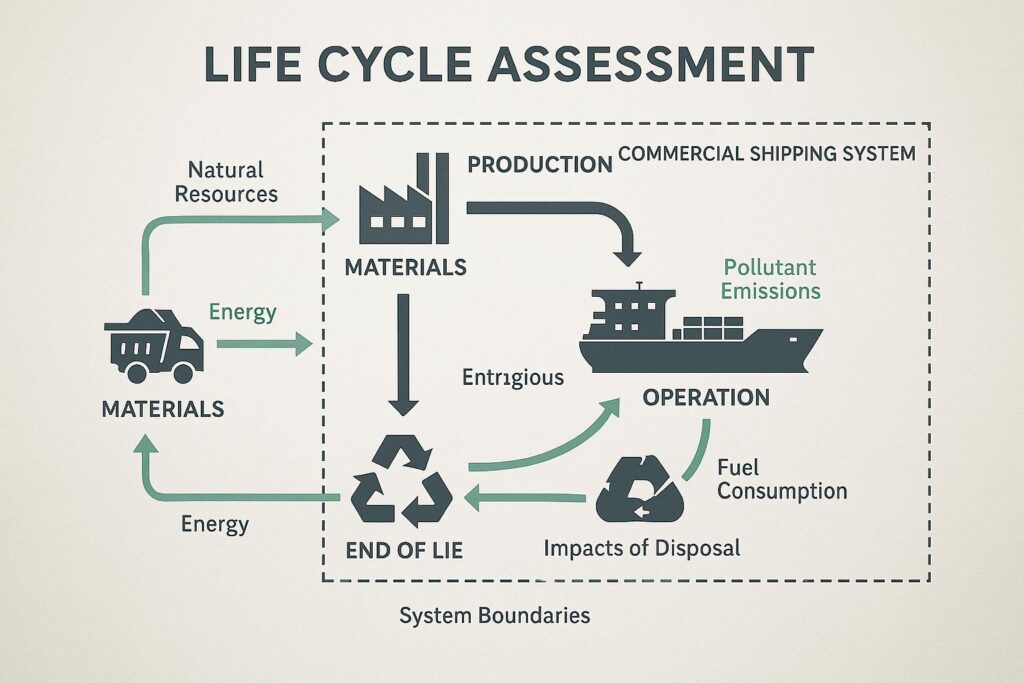
“Life Cycle Assessment (LCA) is a standardized, systematic methodology used to evaluate the environmental impacts of a product, process, or service throughout its entire existence, often described as ‘cradle-to-grave’. It measures environmental impacts from raw material extraction, through production, use, and final disposal or recycling.”
In our industry, the main focus is currently on the life cycle impact of the fuels we consume. This makes sense, due to its proportionately large carbon footprint and because we need to make sure that the fuel decisions we make today are based on as accurate knowledge about the climate and environmental impacts as possible, to minimize the risk that they create new problems for us in the future. Some actors have already started looking at the production of the vessel and its equipment as well, as that will represent an increasing part of our total carbon footprint, as more sustainable fuels are introduced. Further, the language is slowly changing from carbon- to GHG footprint, and more negative environmental impacts, such as water and land use, are expected to also be addressed in the near future. Going forward, we need to address the current challenges, look ‘deeper’ at the issue, and also include aspects such as end-of-life (circularity) in the assessment, and finally we need to figure out how to go ‘broader’ and quantify, implement, and address more environmental impacts in our assessment than just our GHG footprint. LCA should ideally gradually include more of our impact on the environment and biodiversity, as the sources of impact become evident to us.
LCA is already an important tool to point towards our main sources of negative environmental and climate impact, which will allow us to strategically address them and it will likely only become more important in the future. However, there are some central things which must be addressed right away.
We need;
- more corporate incentives, such as regulation or potential competitive advantages derived from LCA
- internationally shared methodologies, to be able to compare numbers and use them for strategic decision making
- to establish collaborations in our supply chains to ensure access to accurate data and increase the validity of our assessments
- inter-compatible software solutions, which address the two points above, and allow us to exchange accurate, and potentially sensitive, data in the supply chain
- to attract more talent and develop more skills, as LCA is still new to our industry