

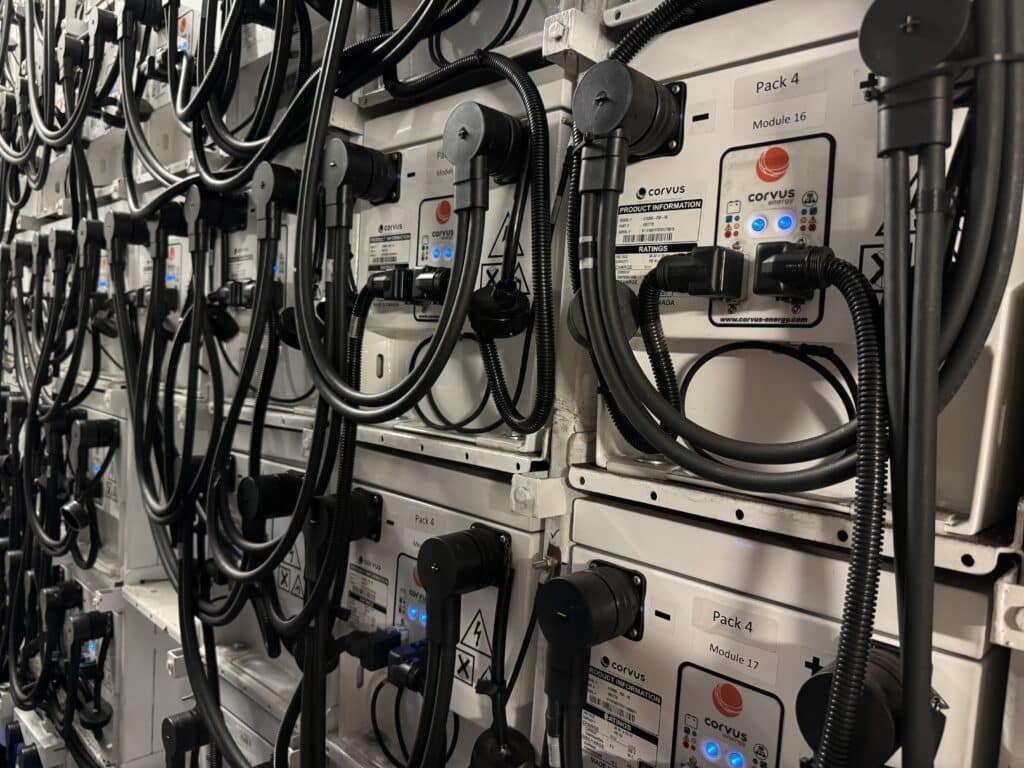
The adoption of batteries and electrical energy storage in maritime applications is set to grow as shipping continues its transition toward sustainable energy vectors. Electrical storage offers significantly higher energy conversion efficiency compared to alternative fuels such as methanol and ammonia, and plays a critical role in hybrid architectures. While energy density limitations prevent batteries from being a universal solution for all vessel types – particularly large, ocean-going ships – the industry is consistently expanding the envelope of what is possible.
In 2025 more than 1,000 vessels were operating with battery systems, and battery-electric propulsion has been built commercially for more than a decade. Despite this, only about 0.5% of the global merchant fleet have batteries installed, highlighting the early stages of market maturity and the need for further development in battery technology, regulatory frameworks, and supporting infrastructure.
Although fully electric vessels often receive the most attention, hybrid solutions – where batteries play a supporting role – constitute the majority of battery-equipped ships, both in operation and on order. Hybrid configurations contribute to enhanced safety, operational efficiency, and emissions performance through functions such as peak shaving, load leveling and transitions, spinning reserve, auxiliary and hotel loads, backup power, immediate power availability, and onboard energy harvesting.
Hybrid solutions
In conventional two-stroke diesel cycle engines – including those running on methanol, in dual-fuel configurations, and in the future on ammonia – there are generally no significant efficiency benefits from using batteries for peak shaving. However, the picture changes for Otto-cycle or low-pressure gas engines, where battery integration can offer measurable efficiency improvements due to the combustion characteristics and load response of these systems.For four-stroke engines, the potential for efficiency gains is more pronounced, particularly in operational profiles involving multiple thrusters or variable load conditions. Still, the extent of the benefit depends heavily on the vessel’s specific duty cycle and power demand dynamics.
Regardless of engine type or fuel, electrical energy storage offers a range of functional benefits for certain vessel types. For instance, reefer ships (container, tankers and bulk carriers etc. that require cargo cooling) or vessels that operates electrically driven cranes or other large equipment, can benefit from battery support. Additionally, many vessel types can utilize batteries in auxiliary functions by replacing one or more gensets. This approach can effectively cover hotel loads, provide blackout prevention, and enable periods of zero-emission operation, particularly in ports or emission-controlled areas.
In the case of two-stroke vessels, onboard battery charging can be performed efficiently during normal operation, reducing reliance on shore-based charging infrastructure. Recently, large cruise vessels have begun investing in substantial battery systems – initially to improve fuel efficiency and support zero-emission operation in environmentally sensitive zones, but blackout prevention has emerged as a critical and somewhat unexpected value driver in these investments.
Rules, Regulation and Standards
Although fully electric and hybrid vessels have been built and operated commercially for over a decade – with more than 1,000 such vessels in service – the process remains significantly more time-consuming and costly than building vessels powered by conventional internal combustion engines and generators.
A key challenge lies in the complexity and inconsistency of the approval process. Risk assessments are often performed twice – once to satisfy flag state requirements and once for class approval. As a result of many shipyards and integrators still lacking experience and deep technical knowledge on battery systems, classification societies maintain a strong focus on comprehensive risk assessments. The concern is that even a single incident could negatively impact not only the stakeholders involved but also the broader marine battery market and, by extension, the maritime industry’s decarbonization efforts.
While some flag states are beginning to move away from the IMO’s Alternative Design framework toward dedicated rules for vessels equipped with battery and electrical energy storage systems, only a handful of countries – primarily in the Nordic region – have issued concrete guidelines or regulations to date. In parallel, although all classification societies operating in Europe have contributed to the EMSA battery guidelines, notable differences still exist in how each class society approaches battery safety and integration. The International Association of Classification Societies (IACS) is actively addressing this issue to work toward harmonized standards.
In contrast to standardized requirements for life-saving and firefighting equipment under SOLAS, where rules and requirements can be looked up and read in detail, the process for conducting risk assessments, HAZIDs (Hazard Identification Studies), and applying alternative design methodologies for battery systems are a lot less transparent. Stakeholders report a lack of transparency regarding class rule interpretations and difficulty comparing approaches or understanding the rationale behind certain decisions.
Another area under scrutiny is the blanket requirement for HAZIDs on all battery-related projects, including both newbuilds and retrofits. Many see this as an expensive exercise with diminishing returns – often conducted out of obligation rather than practical necessity. Execution varies widely: some HAZIDs involve over 20 participants, while others are completed by just two or three engineers. The original value of HAZIDs was greater when class rules were still evolving; now that most major classification societies have formalized standards, many argue that a thorough risk assessment and following class rules can provide equivalent safety assurance. Since all novel components, from battery cells to integrated systems, require class approval before installation, evolving technologies are not necessarily a justification for repeating the process. Furthermore, HAZIDs are not seen as the most effective tool for crew training, especially as only one or two shipowner representatives generally participate in it. Instead, HAZOPs (Hazard and Operability Studies) based on specific operational risks may provide more focused value in training scenarios.
That said, most stakeholders agree that HAZIDs remain highly valuable for shipowners and yards embarking on their first battery-powered vessel projects. Battery suppliers often encounter fundamental knowledge gaps and benefit from joint HAZIDs where experts across disciplines collaborate. HAZIDs are also considered a good idea by most, in complex retrofit projects or when stakeholders intend to deviate from or challenge existing class rules.
Despite growing alignment across the value chain – from suppliers and designers to owners and class societies – firefighting strategies within battery compartments remain a contentious issue and a priority area for further clarification. Additionally, it may be advantageous to develop distinct rules for newbuilds and retrofits, as these present significantly different integration challenges. Finally, while the industry has amassed substantial experience over the past decade in designing, building, and operating vessels with battery systems, this expertise is unevenly distributed. The success of a given project often hinges on the specific flag state, the companies involved, and, critically, the individual professionals assigned to the project. As such, greater transparency, structured knowledge-sharing, and closer collaboration between flag states, class societies, and industry actors remain essential to accelerating progress.
Battery Technology
When it comes to battery technology, a wide range of cell chemistries are in use, including NMC (Nickel Manganese Cobalt), LFP (Lithium Iron Phosphate), and LTO (Lithium Titanate) and many others. Within each of these chemistry families, numerous variations exist, with different formulations that affect properties such as energy density, charging/discharging performance, cost, thermal stability, and cycle life. Each chemistry presents trade-offs, making specific types more or less suitable for different maritime applications depending on operational profiles and technical requirements.
New variants and formulations are introduced frequently, often accompanied by bold performance claims. While this technological innovation is positive, it also creates uncertainty for shipowners and operators. Most owners are not concerned with the specific chemistry; their primary interest lies in ensuring that the solution meets safety, durability, and performance requirements. The proliferation of options, combined with a lack of transparency and standardization, increases the risk of adopting technology that could later become obsolete, incompatible, or subject to regulatory restrictions. There is also concern about investing in battery systems containing materials that may later be banned or scrutinized due to environmental or geopolitical factors.
Battery supply chains are highly geopolitically sensitive and rely on scarce and volatile raw materials, such as lithium, cobalt, and nickel. These resources are in high demand across multiple sectors, including electric vehicles and grid storage, which could impact availability and pricing for maritime applications.
Sustainability remains another significant area of concern. While lifecycle assessments focusing on greenhouse gas emissions generally favor batteries over fossil fuels and alternatives fuels like ammonia and methanol, broader environmental and social impacts are less well understood. These include issues related to mining practices, local environmental degradation, use of toxic chemicals such as PFAS and solvents, and the human rights implications of resource extraction in certain regions.
End-of-life management of maritime batteries poses additional challenges. While the idea of second-life applications – such as using marine batteries for stationary land-based storage – has been widely discussed, practical implementation has proven difficult. Maritime batteries are not designed for such reuse, and repurposing them typically requires labor-intensive and costly modifications. Recycling also presents difficulties: although many battery materials are technically recyclable, recovering high-purity materials – particularly rare ones – is energy-intensive and often economically unfeasible. Cobalt recovery currently provides the only viable business case for recycling, but the industry is actively moving away from cobalt-based chemistries due to cost, ethical, and supply chain concerns. Rapid shifts in cell technology further complicate recycling, as each chemistry requires different processing methods.
Given these sustainability, supply chain, and regulatory concerns – and their critical importance to the energy transition – batteries are receiving increasing regulatory attention. The EU, for instance, has already implemented several rules under, with additional policies expected. While these regulations aim to improve environmental performance and supply chain transparency, they also introduce further complexity and uncertainty for maritime battery adoption.
Despite these challenges, batteries and electrical energy storage systems hold strong potential to contribute to shipping’s decarbonization goals. They offer advantages in terms of emissions reduction, noise mitigation, safety, and operational flexibility. As such, they should be considered an integral part of fleet planning, whether for newbuilds, retrofits, or hybrid integrations – and should be evaluated carefully in consultation with technical advisors and suppliers.